Showing posts with label Reactions. Show all posts

Monday, September 19, 2011

Krebs cycle (reactions) - part 2

Reaction 5: conversion of succinyl-CoA to succinate This reaction requires Mg2+. The enzyme that catalyzes this reaction, succinyl-CoA synthetase, breaks the thioester bond (S-CoA), releasing a large amount of energy that is used to phosphorylate GDP to GTP. It is another example of an energy coupling.


Reaction 6: oxidation of succinate to fumarate
Succinate is oxidized to fumarate, leading to the production of FADH2 from FAD. The reaction is catalyzed by succinate dehydrogenase, which is the only Krebs cycle enzyme that is not present in the matrix, but instead is strongly associated with the inner membrane of mitochondria.


Step 7: Hydration of fumarate to malate
This enzyme is highly stereo-specific, producing only the stereoisomer L-malate. The reaction is reversible in cellular conditions.


Step 8: oxidation of malate to oxaloacetate
This reaction produces a molecule of NADH from NAD+. At the intracellular conditions, the reaction is mainly driven in the opposite direction, but as the oxaloacetate is continuously removed (by the reaction of synthesis of citrate, by gluconeogenesis or by transamination to originate aspartate), the equilibrium is shifted in the forward direction. The oxaloacetate used in the first reaction of the Krebs cycle is then regenerated, so, theoretically, one molecule of oxaloacetate may be involved in the oxidation of an infinite number of molecules of acetyl-CoA (playing a kind of "catalytic" role) and, therefore, the oxaloacetate is present in cells at very low concentrations.
  
Main bibliographic sources:
- Quintas A, Freire AP, Halpern MJ, Bioquímica - Organização Molecular da Vida, Lidel
- Nelson DL, Cox MM, Lehninger - Principles of Biochemistry, WH Freeman Publishers

Friday, September 9, 2011

Krebs cycle (reactions) - part 1

Reaction 1: formation of citrate
This irreversible reaction is the 1st regulatory point of the Krebs cycle. It is a reaction in which an oxaloacetate molecule reacts with acetyl-CoA. In this process it is formed a very energetic intermediate (citroil-CoA) that rapidly converts into citrate. The molecule of CoA-SH liberated is recycled to participate in a new oxidative decarboxylation of pyruvate (catalyzed by pyruvate dehydrogenase complex).

Reaction 2: formation of isocitrate via cis-aconitate
This reaction occurs through the formation of an intermediate, cis-aconitate, obtained by dehydration of citrate. Thereafter, the cis-aconitate is hydrated, forming isocitrate. Thus, citrate and isocitrate are isomers. Despite that in cellular conditions the reaction produces only about 10% of isocitrate, the rapid consumption of this product in the following reaction shifts the equilibrium in the forward direction. The fluoroacetate is a toxic molecule because in physiological conditions it is transformed into fluoroacetil-CoA, which condenses with oxaloacetate to form fluorocitrate, that inhibits aconitase, causing accumulation of citrate.


Reaction 3: oxidation of isocitrate to α-ketoglutarate and CO2This reaction is an example of an irreversible oxidative decarboxylation, and it is the 2nd regulatory point in the Krebs cycle. In fact, this reaction is a set of three different reactions:
1. Dehydrogenation of isocitrate, creating oxalosuccinate and producing NADH.
2. Binding of Mn2+ to the carbonyl group of oxalosuccinate, stabilizing the enol and promoting the release of CO2.
3. Hydrogenation, with the arrangement of the resonance hybrid.


Reaction 4: Oxidation of α-ketoglutarate to succinyl-CoA and CO2This reaction, like the previous one, is another example of an irreversible oxidative decarboxylation. It is the 3rd (and the last one!) regulatory point of the Krebs cycle. This reaction is virtually identical to the oxidative decarboxylation of pyruvate, also leading to the formation of NADH. It is a very exergonic reaction due to the energy stored in the bond S-CoA.


Main bibliographic sources:
- Quintas A, Freire AP, Halpern MJ, Bioquímica - Organização Molecular da Vida, Lidel
- Nelson DL, Cox MM, Lehninger - Principles of Biochemistry, WH Freeman Publishers

Sunday, July 10, 2011

Glycolysis (reactions from the payoff phase)

Following a previous post, in which I have detailed the reactions of glycolysis (preparatory phase), here are the reactions of the second part, the payoff phase.

Reaction 6:
This reaction is catalyzed by glyceraldehyde-3-phosphate dehydrogenase and it is a double reaction. The substrate will be oxidized (the carbonyl group is a carboxylic acid), and then will be added to a carboxylic group phosphorylates newly formed through a phosphoester linkage. Therefore, the reaction produces NADH (oxidation of substrate) and consumes inorganic phosphate (Pi). This addition of the phosphoryl group will give the product (1,3-bisphosphoglycerate) a high potential for transfer of phosphoryl group, ie, the molecule will become chemically unstable, because it is a small molecule (only have 3 carbons) but with many electronegative atoms (electrostatic repulsion will be many). This instability will be useful to understand what goes on in the following reaction...

Reaction 7:
This is the first reaction of glycolysis that will lead to the synthesis of ATP and requires the presence of Mg2+. It is catalyzed by the enzyme phosphoglycerate kinase (the name derives from the enzyme reverse reaction, which occurs during photosynthetic fixation of CO2). I've mentioned in the previous reaction that formed a compound chemically unstable. This instability will cause the 1,3-bisphosphoglycerate to display a tendency to lose one of its phosphoryl groups (leading to 3-phosphoglycerate), releasing a large amount of energy (remember that a molecule is much more stable and have less internal energy…). Therefore, if it releases the phosphoryl group, it becomes more stable, because it loses energy. This energy will be used to engage a reaction to the second reaction (which requires energy to occur): the synthesis of ATP! In fact, the phosphoryl group is added to the released ADP, resulting in ATP. As the phosphoryl group is derived from a substrate, the synthesis of ATP is called phosphorylation level of the substrate. However, the question that probably some will be thinking is: "So it was better to add once the phosphoryl to ADP in the previous reaction? Why do we bother to first transfer it to a interemediário, if we in the following reaction remove? " The answer to this question relates to the thermodynamics of the reactions involved. That is, the energy released in the oxidation reaction in the existing 6 is not as high as it is necessary to spend in the synthesis of ATP. Therefore, there are only two chances ... Or do not use that energy from oxidation, but this is a waste, or retains a part of the energy released in the form of chemical energy, the 1,3-bisphosphoglycerate (this is what happens!). So in the following reaction we'll have enough energy to synthesize ATP. Together, the steps 6 and 7 show the role of phosphate groups in the conservation of metabolic energy, which I mentioned in post about the reactions of the preparatory phase of glycolysis.

Reaction 8:
The enzyme that catalyzes this reaction is the phosphoglycerate mutase and is dependent on Mg2+. What will make this enzyme is to transfer the phosphate group from position 3 to position 2 of the substrate. In reality, this transfer is not direct ... The active enzyme has a phosphate group, which transfers to the substrate, leading to an intermediary known as 2,3-bisphosphoglycerate. This molecule is an important modulator of the affinity of hemoglobin for O2! Thereafter, the 2,3-bisphosphoglycerate yields a phosphate group to the enzyme, converting it into 2-phosphoglycerate and regenerating the active form of the enzyme.

Reaction 9:
This reaction is catalyzed by enolase and is an example of a reaction of elimination. What this enzyme will do is remove a water molecule of the substrate, creating a double bond. As the double bonds are electron-rich regions, its presence in the vicinity of the phosphate group will make your product, phosphoenolpyruvate, again presents a high potential for transfer of phosphoryl group. This reaction requires the presence of Mg2+.

Reaction 10:
We came to the last reaction of glycolysis ... In this reaction, catalyzed by pyruvate kinase (the third regulatory enzyme of glycolysis!), the phosphoenolpyruvate will lose the phosphoryl group, releasing a large amount of energy. Again, this energy will be partially preserved in the form of an ATP molecule. This reaction is irreversible and requires the presence of Mg2+ (or Mn2+) and K+.

Main bibliographic sources:
- Quintas A, Freire AP, Halpern MJ, Bioquímica - Organização Molecular da Vida, Lidel
- Nelson DL, Cox MM, Lehninger - Principles of Biochemistry, WH Freeman Publishers

Friday, July 8, 2011

Glycolysis (reactions from the preparatory phase)

How many times you were looking to a metabolic map and thougt: “This looks like chinese, for me!”?
In this post I will try to make that this kind of thought will not appear, at least when you look to a metabolic map about glycolysis.

Before I start to describe the 10 reactions of glycolysis, there is na important issue to consider…
All the 9 glycolytic intermediates are phosphorylated, that is, they possess at least 1 phosphate (phosphoryl) group. Those groups are important for 3 important functions:
1. Since they are ionized (possess negative charge) at the intracellular pH, that is about 7 units of pH, the glycolytic intermediates will display such charges. It is important to note that glycolysis is a cytosolic process and, thus, our cells do not want that the glycolytic intermediates diffuse to the outside of the cell. As the plasma membrane is impermeable to charged molecules, the presence of phosphoryl groups causes the cell does not need to spend any extra energy to keep the glycolytic intermediates inside, regardless of their intra-and extracellular concentration.
2. Since the phosphoryl groups are part of the substrate of the glycolytic enzymes, the binding energy resulting from the interactions established between these groups and the active site of the enzyme lowers the activation energy and increases the specificity of enzymatic reactions involved.
3. They are essential components in the conservation of metabolic energy. This is a very important aspect, which will allow for channeling a large part of the energy in biochemical reactions for the synthesis of ATP.


Let's start to "dissect" glycolysis…
Reaction 1:
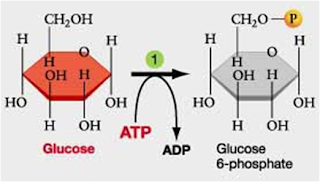
In this reaction, catalyzed by the enzyme hexokinase, glucose is phosphorylated (receive a phosphate group. The phosphate group donor is ATP, which is converted to ADP, ie, there is an energy expenditure associated with this reaction. The phosphate group is then added to carbon 6 of glucose through a phosphoester linkage, forming glucose-6-phosphate. This reaction requires the presence of Mg 2 + ion and is irreversible in cellular conditions.
At first it might seem a bit odd that we are spending ATP in this reaction ... So it was more advantageous to add the phosphate group is an inorganic phosphate existing in the cytosol? So there we spent energy...
However, as I often tell to my students: "Nothing comes by chance in biochemistry!" There is a very simple explanation for this situation. What is happening is that the addition of a phosphate group to glucose is a thermodynamically unfavorable reaction, ie, requires energy. This energy requirement is essentially a consequence of glucose is very rich in electronegative atoms and phosphate also be very electronegative. That is, to make the addition of the phosphate group is necessary to provide energy to overcome the electrostatic repulsions that arise. If the group was to add an inorganic phosphate from the cytosol, the reaction did not occur, because there was enough power to do so. On the other hand, there is a cellular source of phosphate groups which has a large amount of chemical energy - ATP! Therefore, the cell performs an energy coupling, ie, joins a thermodynamically unfavorable reaction (addition of a phosphate group to glucose) to a thermodynamically favorable reaction (ATP hydrolysis). As the energy released is greater than the energy expended, the reaction occurs in the cellular context.
Finally, one important aspect that will deserve a post soon. This reaction is the first point of regulation of glycolysis. Despite this, there is a reaction unique to glycolysis, is also common to other processes that use glucose. Basically, a reaction that occurs is poorly glucose enters the cell, thus preventing it from getting out of it.

Reaction 2:
This is an isomerization reaction in which glucose-6-phosphate (which is an aldose) is converted to fructose-6-phosphate (which is a ketosis). The enzyme that catalyzes this reaction is fosfohexose isomerase. It is a reversible reaction requires the presence of Mg2+ ion.


Reaction 3:
In this reaction, fructose-6-phosphate is phosphorylated at carbon 1, settling down again causing a phosphoester linkage and fructose-1 ,6-bisphosphate. The enzyme that catalyzes this reaction is phosphofructokinase-1 (PFK-1), which is the second regulatory enzyme of glycolysis. This reaction is the main point of regulation of glycolysis and is therefore irreversible in the cellular conditions! It requires the presence of Mg2+.
Again, the donor of the phosphate group is the ATP for the same reasons described above for the reaction 1. The addition of a second phosphate group will increase the instability of the final product because the amount and proximity of electron-rich regions increases.

Reaction 4:
This reaction, catalyzed by aldolase, is responsible for the suffix "analysis" in the word glycolysis. In fact, will promote the aldolase cleavage of fructose-1 ,6-bisphosphate (which is a hexose, it has 6 carbons) in glyceraldehyde-3-phosphate and dihydroxyacetone phosphate (both are trios, they have 3 carbons). This reaction is possible due to the instability that fructose-1 ,6-bisphosphate has as a consequence of the presence of several regions with a high electronegativity (phosphoryl groups and hydroxyl groups).This reaction is reversible, but the rapid consumption of trioses formed causes the equilibrium is shifted in the forward direction.

Reaction 5:
For the remaining steps of glycolysis, it is only possible to use the glyceraldehyde-3-phosphate molecule. As it was a waste not to use the dihydroxyacetone-phosphate, because this molecule contains half of the carbon atoms of glucose, it is converted into glyceraldehyde-3-phosphate by the action of triose phosphate isomerase. Thus it is possible to use the 6 carbons of glucose in this pathway! Once again we have an isomerization reaction, in which case we have the reverse of that in reaction 2, ie, a ketosis (dihydroxyacetone phosphate) is converted into an aldose (glyceraldehyde-3-phosphate). This reaction can occur in both directions, with the majority of the molecules tends to be in the form of dihydroxyacetone phosphate. However, since the glyceraldehyde-3-phosphate is quickly consumed, the balance shifts in the forward direction.
As of this reaction, all expenses and gains of glycolysis must be multiplied by 2 because we now have two molecules of glyceraldehyde-3-phosphate per molecule of glucose.


Main bibliographic sources:
- Quintas A, Freire AP, Halpern MJ, Bioquímica - Organização Molecular da Vida, Lidel
- Nelson DL, Cox MM, Lehninger - Principles of Biochemistry, WH Freeman Publishers